Wednesday, October 6, 2010

The slow season on reserve

The weeks in between Labor Day and Thanksgiving are historically low travel periods for airlines. Kids are back in school and not many people are taking vacations. Flying for an airline that mainly caters to vacationers, September and October are very slow months. In fact, in 2008, my furlough occurred immediately after Labor Day. Basically, right now I'm just happy that I'm not back in that same spot.

I only flew 30 hours in September, way down from the 80 hours a month I've been flying since June. To be honest, it was a relief! I was exhausted. I didn't want to see an airplane ever again! I felt like I hadn't slept in my own bed in 3 months. I'm pretty sure in August I actually slept more in our crew hotel in Ft. Lauderdale than I did in my own bed.

Unfortunately as a result of the busy schedule I had to drop my graduate class. The first 3 weeks of the class I flew so much that I could not keep up with the coursework. The transition (the period of time when one month is ending and another begins, and is typically a hectic period for scheduling; I flew 10 days with only 2 days off in the middle) really did me in. I hope to pick back up with classes soon.

While my days off have been pretty chock full of fun activities (visiting family, exploring Pennsylvania) my reserve days haven't been. When I'm on reserve I really can't venture too far from the house. Our airline rules stipulate that I must be in the cockpit ready to go w/in 3 hours of a phone call from scheduling, if that flight is scheduled to leave by then. Typically I get an assignment the day before but you never know when someone will call out sick for their trip at the last minute. It takes me 2 hours and 10 minutes, on average, to drive to the airport, which luckily is plenty of time to park, get through security and get to the airplane (gotta love working at a small airport!). The captain will typically do the walk around and other checks normally left for the first officer if he knows he or she is coming in on a late call out.

In short, I'm basically stuck to an area that includes my apartment, the airport my boyfriend flies out of, and the grocery store.

I've always been interested in cooking and baking. Living with someone who will literally eat ANYTHING really helps; I can make anything I can think of and I know David will eat it. And being on reserve gives me the time and opportunity to stay at home and explore dishes that I would typically never dream of making.

Here's most of my cookbook collection:


I'm completely obsessed with Irma Rombauer's "Joy of Cooking." Every recipe I've made out of this has been perfect. Many of the recipes date from pre-WWII. I'm not sure why this is, but I love the idea that I'm making something that a woman in the 1930s was making.

Another incredible success was the chocolate babka from Gourmet. Babka is a traditionally Eastern European dessert, a sort of sweet bread loaf with chocolate filling. I've grown up on babka's brought back by my Bubbe from NYC.


After being inspired by Mrs. Wheelbarrow on a recent NPR episode, I tried my hand at canning. I made her Apple Pie Jam, which tasted delicious but unfortunately did not set up as firmly as jam should be. It's more of a marmalade. Not bad for a first try, though!


The weather has been cold and rainy all week, so I've been inspired to make stews and soups. I don't have pictures of my butternut squash and chicken soup or yesterday's ratatouille, but here's the beef and barley stew I made last night. I made it from a Weight Watchers recipe, which uses parsnips and celery root to replace the potato. They're starchy enough that you don't even miss it!


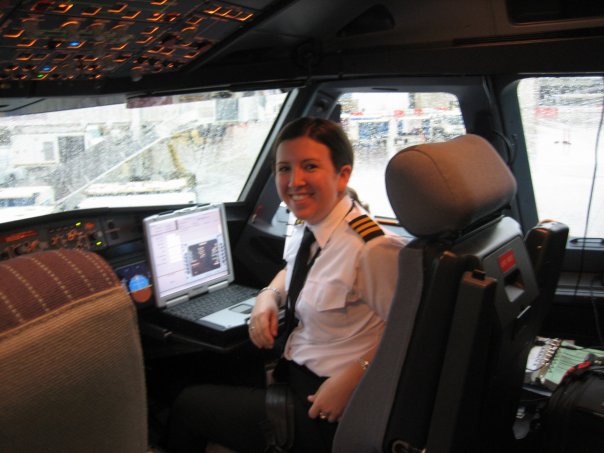
In the future you can expect a nice mix of flying, cooking and knitting, which are swiftly becoming my top 3 hobbies. I joke around and tell people that "inside this airline pilot is a 1950s housewife screaming to get out." Maybe a girl will read this and see that you CAN be kick-ass and girly. It's not hard, all you need is a little cabin fever.

Blue Skies!!

Thursday, September 23, 2010

A320 parking brake incident

The NTSB released a preliminary report on the tire blowout incident on an August 26th JetBlue flight. Thanks to Airline Pilot Central for the article.

The NTSB decided that the A320's parking brake was on when the aircraft landed, resulting in the main landing gear tires blowing out and a small fire. Thankfully all the passengers and crew evacuated safety.

I went straight to my manuals to determine whether or not the pilots should have received any indication that their parking brake was on in flight. Here are two screen shots from my manual so you can see for yourself. I won't go into the specifics of which computers monitor the parking brake or anything heavy like that because I want this to be a quick and dirty post. Please post or tweet me questions and I will write a more detailed description tomorrow (when there aren't fall premiers on TV distracting me).


This page illustrates the 10 different phases of flight that the computer's logic uses to decide when to display messages or when to inhibit them. This says that if the parking brake is one during phases of flight 6 and 7, a single chime and master caution will be generated. This would present as a amber memo on one of the center display units, an aural DING!! and the master caution lights will illuminate. This is any time after the plane has climbed through 1500 feet until it touches down.


On the next page we see that when the parking brake is on during all other phases of operation, which are considered normal times to have the brake on, the crew will get a normal green annunciation.

It will be interesting to watch the investigation progress to see if the crew did receive the caution from the airplane's computers. There is a tendency among A320 pilots to label some cautions erroneous. I've had plenty of cautions that we investigated only to find that there wasn't a problem in the first place, a downside to flying such a computer-reliant machine.

EDIT: Thanks to Tweep @thermalhound for the following reminder: "Just read your blog on PARK BRK on. FYI not all a320s on same s/ware so some only display PARK BRK ON on ECAM but no "DING!""

He makes a very good point. These logics are out of my airline's manuals, and JetBlue's software on their A320s very likely differs in many ways from ours. So take what I'm saying with a grain of salt.

Monday, May 31, 2010

Line checks, SOPs and reserve, oh my!

Greetings! I have great news! As of May 29th I’m a full-fledged first officer once again! I passed my proficiency check in the full-flight simulator and flew 15 hours on the line. After those 15 hours I had to take a line check, as specified by the new “pro pilot guidelines.” As a result of the Colgan crash in Buffalo, the FAA instituted new rules for airlines with low-time pilots. I already meet the “time in type” requirement but since I have not flown with the airline for 13 months I’m still part of the program.

Just mention “line check” to most pilots and they break out into a cold sweat. But if you’re proficient in the aircraft, always abide by your standard operation procedures (SOPs) and keep your charts and manuals updated, a line check won’t be so stressful. The problem lies when pilots suffer a “brain dump” after their yearly training. They forget their limitations, have a tendency to not follow SOPs and will have a stack of chart revisions in the bottom of their flight back. There’s a simple solution: don’t dump all that useful knowledge the day after your proficiency check!
My personal flying philosophy is “fly like you’ve trained. Fly the same way every day, and when something goes wrong, you’ll perform how you’ve been trained to perform.” The best pilots I’ve flown with are the ones that follow their SOPs. There shouldn’t be any surprises in the cockpit, at least within the crew. SOPs are designed so that, even if you just met your captain five minutes ago, you can still safely operate a flight.

Enough soap box!

Currently I’m sitting at TPA, my home airport (for now!). Tomorrow is June 1st and I have a reserve line this month. When you’re on reserve you are on call during a certain time period (this month it’s 0200-1600) and the company will assign you flights that have not been covered. Most of the time you’re assigned flights that weren’t covered by scheduling during the initial bid period and sometimes you are filling in for a pilot that’s called in sick. Since I have to work in the morning I’m taking a flight this afternoon to ACY.

I was scheduled to be on reserve the 1st and 2nd, but have already been assigned a trip for those two days. I called crew scheduling this morning just to make sure my line check/training paperwork had been put through (making me available to fly the line). They said it had and that they already had a trip for me! Technically they can’t call me on my day off. They would have called at 2am tomorrow morning, though! So I’m glad it worked out.

Tomorrow I will be flying ACY-BOS-FLL-DTW, starting at 0930 and getting into DTW around 1930. I overnight in DTW then fly one early-morning leg back to ACY at 0600. I can even get back to Tampa the same day! I’m so happy to be back flying. Hopefully the trip goes smoothly! Details at 11 ;)

Sunday, May 16, 2010

SOPs and SMAC

We've been very busy for the past week, so I apologize for not updating! Today was my first procedures training FTD after three wonderful days off.

Unlike in the systems integrated training from last week, this week's FTDs place emphasis on flows, checklists, call outs and approach procedures. Today my partner and I each performed an emergency descent, a RNAV approach and a NDB approach. RNAV and NDB approaches are flown almost exactly the same in the A320, using what's called the APP NAV strategy.

With the APP NAV strategy the aircraft actually uses raw data (i.e. the NDB signal) as a backup to GPS waypoints. Basically, the NBD final approach fix is treated the same as the GPS waypoint FAF on the RNAV approach. You monitor raw data while performing the NBD approach but rely on the airplane's GPS and IRS navigation to shoot the approach. Just follow the flight directors and VOILA, you're there.

Actually, we're taught the fly the whole thing on autopilot until the runway environment is in sight! Then you can click off the autopilot and land the airplane. If you don't see the necessary requirement to land before reaching the approach minimums, you initiate a go-around by moving the thrust levers to the TOGA detent. The A320 will do the entire go-around without any additional pilot input. If you wish to fly the published missed approach you press the heading bug to tell the autopilot you wish it to fly the missed and it will fly to the altitude, fix and hold right there until you tell it otherwise. Lazy? yes. Neat? TOTALLY.

Tomorrow we'll be concentrating more on the correct call outs and practicing the approach briefing. Call outs are crucial to following standard operating procedures (SOPs) and help with situational awareness for both crew members. The newest and most critical is the "stable/unstable" call out. More about that tomorrow!

Saturday, May 8, 2010

I owe you a post!

I'm sorry that I haven't been updating daily, but even ground school is exhausting! I have a day off today, however! Today's agenda is to take advantage of the great weather and study by the hotel pool.

Tomorrow I start SITs. In the SIT we practice operating the aircraft systems in situations more like what we'll be seeing on the line. I hope I do well! It's been 18 months since I've been in the cockpit so I feel out of practice. After I've gotten enough UV rays today I'll come back inside to practice my flows on the cockpit posters I have in my room.

I'm going to avoid discussing our union issues in the blog, as I'd rather keep my mind on training. I will say, however, that I truly hope the union and the company come to an agreement before a strike -- striking keeps us out of the cockpit and keeps the company from making money; it's not good for either party. At the same time, however, we won't sacrifice our quality of life. You can read the Airline Pilots Association's press release here.

The other day in class we discussed landing distance multipliers and factors that necessitate an increase in approach speed. After the Southwest Airlines runway overrun at Midway airlines have focused on ensuring adequate runway distance available.

We spent a decent chunk of time on a new flow chart that we can use to decide how many knots we need to add to our approach speed, as well as any increases in runway distance (called multipliers). A small change in aircraft configuration due to a malfunction or even a strong crosswind can increase landing distance by 10% to 35%.

Our normal Vapp in the A320 is around 123-126 knots. Some malfunctions such as inoperative flaps will significantly increase Vapp. Approach speed sometimes must be increased up to 20 knots.

The procedure keeps you aware of how the malfunction (or weather) can affect your landing speed and distance, something that pilots flying any type of airplane, from a C150 to an A380, could definitely apply.

Another major safety initiative highlighted in our training is stabilize approaches - but I'll save that for another blog post!

Monday, May 3, 2010

Ground school, day 1

Today was our first day of ground school! We received new manuals, Jeppesen charts and IDs (we had to turn these in when we were furloughed).

The purpose of ground school is to bring us back up to speed on aircraft systems and company procedures. Today we spent about 9 hours on systems, and still didn't finish the whole review! It's assumed that, since this is recurrent, that you have a basic grasp on the A320 systems so most of the information involved non-obvious facts.

The first thing pilots perform when entering the cockpit for the day is to perform a cockpit preparation and preflight. We used this as the backbone for our systems study. The pilots check the various systems to make sure nothing is broken. The logbook gets reviewed for any inoperative items, and we look up any procedures that we need to perform as a result.

Flows are an important part of airline training. A flow is basically a checklist that you perform from memory - it tends to move in an easy-to-remember pattern that "flows" around the cockpit. The cockpit preparation flow moves up and down the overhead panel, across the instrument panel, and down the center pedestal. We check to make sure all the systems that should be on are active, make sure our emergency oxygen system is functioning correctly and ensure that required items (such as landing gear pins and windshield rain repellent) are in the airplane and filled.

While discussing the flows in class today we stopped and discussed the corresponding systems. It's a nice way to review aircraft systems while covering a little bit of procedures training.

In other news, it's so nice to be back. I feel like I can finally believe that I've been recalled and am going back to work! I'm waiting for my boyfriend to get done flying for the day so I can tell him all about it. :) Until then, perhaps some dinner and studying with my classmates!

Sunday, May 2, 2010

Turn on the fire hose!

Well I am in Ft. Lauderdale, ready to start training! This week is all ground school, starting at 0800. I did a bit of studying tonight but I am so exhausted from driving that I'm choosing to go to bed early instead! I want to be refreshed and ready for class tomorrow.

I will try my best to update every day!

Starting tomorrow I will definitely feel as if I'm drinking from a fire hose! Wish me luck!